What I'm building
I'm one person. The building is done by a team of AI agents — they plan, write, and review the code, while I stay on the decisions that actually need a person. So far that crew has built three products — none of them ready for general availability — plus the system that builds them:
- Pulse — a personal assistant that connects your email, calendar, health, and tasks, tells you what actually needs you today, and keeps all of it on your own machine.
- Agentic Media — AI agents that plan, negotiate, and optimize ad campaigns across publishers in real time, speaking the new open standard for agent‑to‑agent ad buying (AdCP). It runs on synthetic campaigns today, but it's built for real ones: the buyer side is built and tested (still being validated), and the next piece is wiring up the sell side (real publishers, starting with Google Ad Manager).
- Video Intelligence — the very first thing I built, back before Claude Code: it turns long expert videos into a searchable research assistant. It pulls out the key points, checks the claims against the actual research, and answers your questions by researching across everything it has watched, instead of making you sit through it.
- The factory itself — the most ambitious one: the system that lets a single person run all of the above at once. It's the real project; the products are how I find out whether it works.
A caveat worth being upfront about: none of this is ready for general availability yet. Pulse and Video Intelligence began as tools I built for myself, and I'm now working to productize both so other people can use them, not just me. Agentic Media runs on synthetic campaigns for now, but it's built for real ones — the next step is integrating the sell side (real publishers) so it can move actual money. They are real, working prototypes, and whether any of them holds up at scale is the open question I'm building toward. And one more thing worth saying: doing all of this as one person has been genuinely consuming. I used to build platforms like Agentic Media with a team of 50+ product and design people and 200+ engineers; now it's me and a crew of agents. It's been great learnings, and lots of work in progress.
How the factory works
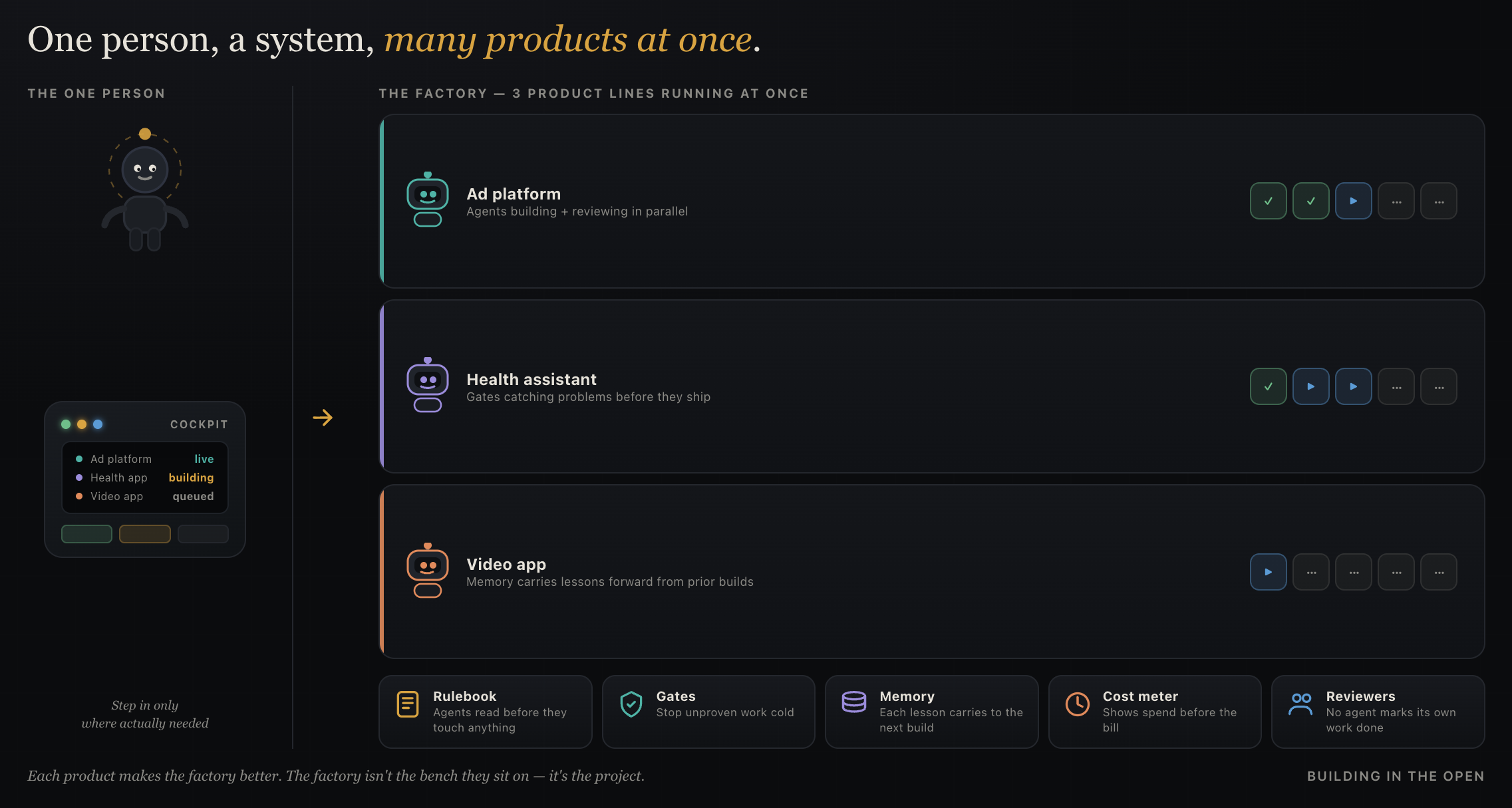
None of this works by handing one clever AI the whole job. It works because of a system of unglamorous parts that keep the agents honest:
- Rules the agents read before they touch anything, so they stop guessing where I was unclear.
- A team with real jobs — some build, some review, some are paid only to find what's wrong — and none gets to mark its own work done.
- Gates that physically stop work that hasn't proven it works, instead of polite notes asking it to behave.
- A memory, so each session starts from what the last one learned.
- A cost meter, so I see the spending before the bill does.
- A dashboard where I watch every product at once and step in only where I'm actually needed.
Where humans still matter — and where it still breaks
The agents are good at execution and bad at judgment. Left alone, they declare things done that aren't, fix one bug and miss its siblings, and run in circles convinced they're working. So the human stays on the parts that matter: deciding what's worth building, approving anything that touches the real world or real money, and catching the confident‑but‑wrong. A lot of the posts here are about exactly those failures — because that's where the real lessons are.
The words I use
A few terms show up across the posts. Here's what they mean, in plain language:
- Session
- One continuous, open conversation with the AI tool I build in. It holds the running context — what I'm building, what I've already tried, what broke and why. Lose it and the code is fine, but the agent's understanding of the work is gone.
- Agent
- An AI doing a job. I use the word three ways: a coding agent writes the code; a reviewer agent checks it (never its own work); a product agent runs inside a product, like the assistant in Pulse. Under the hood these are prompts, rules, and workflows — not human-equivalent employees.
- Gate
- A check the system runs on its own that blocks work which hasn't met a rule. Not a note asking the agents to behave — a wall they can't route around.
- Reviewer
- An agent whose only job is to find what's wrong, kept separate from the agent that built the thing. Nothing counts as done until a reviewer that didn't write it signs off.
- Memory
- What one session writes down so the next one starts from it — decisions, dead ends, lessons — instead of relearning the same mistake from scratch.
- Dashboard
- The one screen I run everything from: every product at once, what's costing what, and the few things that actually need a decision from me.
- Venture / product
- One of the things I'm building — Pulse, Agentic Media, Video Intelligence, and so on. The factory is the system that builds them.
Where to start reading
Three honest ways in. Pick whichever fits how you came:
Elsewhere
This is the build diary. For more about me and my other work, see pmtsai.dev.