Status: prototype — the buyer side is built and being validated against synthetic campaigns; real publisher (sell-side) integration is the next step. No live advertising money has moved through it yet. Screenshots show sample data.
Every post on this blog so far has been about how I build. The rules, the agents, the verification gates, the dashboard. The factory itself.
This one is about what I am building with it.
The product is called Agentic Media. It is a media-buying platform run by software agents — agents that plan, pace, and optimize advertising campaigns across channels: connected TV, streaming audio, digital billboards, linear television. The agents do the operational work. The human approves the calls that need a human.
That is the whole idea. And when I say it out loud, it sounds exactly like the system I built for myself.
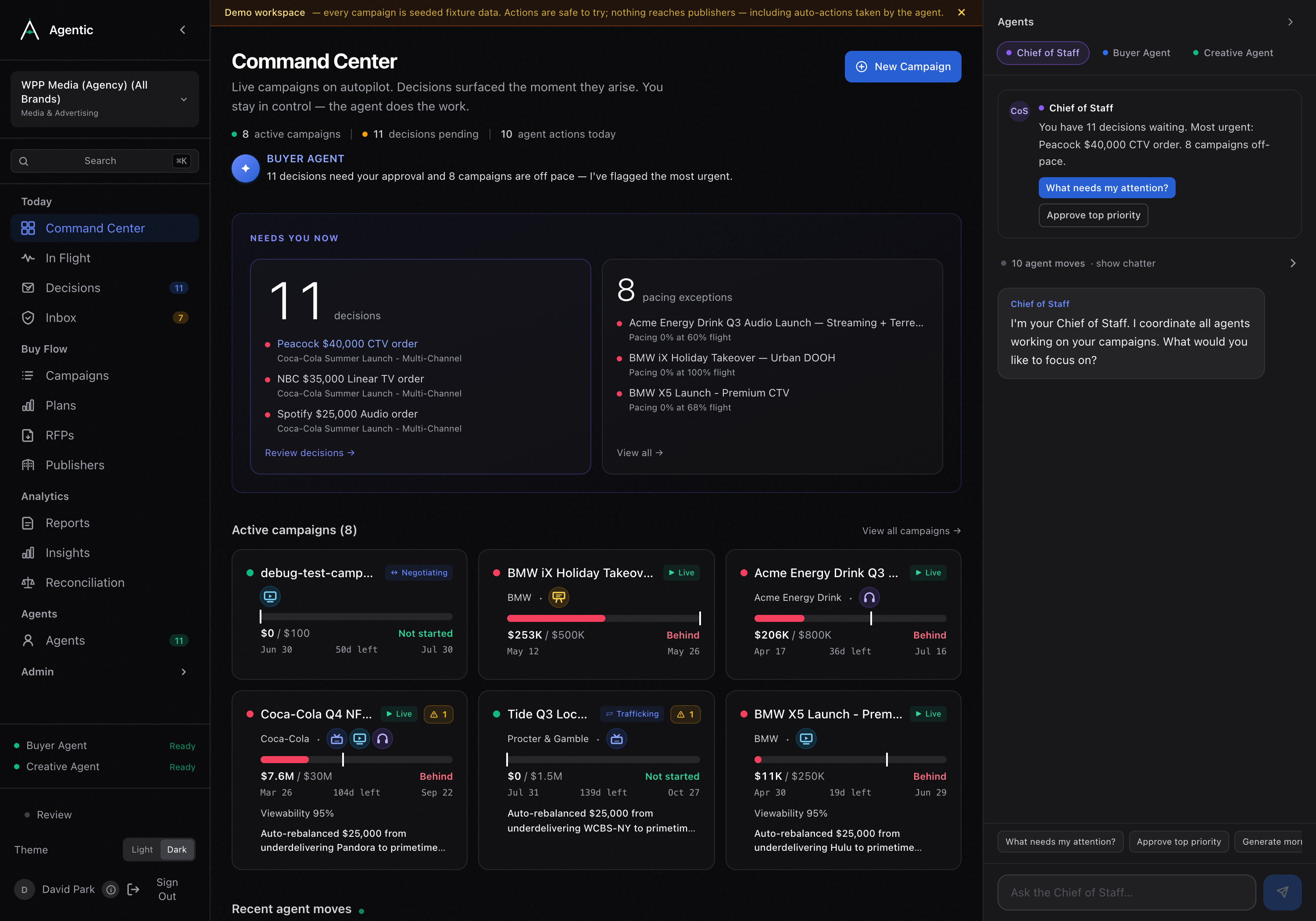
The Command Center shows every active campaign. A Chief of Staff agent coordinates the work. A Buyer Agent runs the actual buys. A Creative Agent handles the assets. Each week they take more of the routine work — placing an order, tracking delivery, adjusting pacing when a campaign is falling behind — and my job is to keep finding where they still need a person.
What they do need a person for are the calls with real consequence.
A campaign is pacing 40% behind with two days left. Does the agent push harder or let it miss? A new inventory slot opens up at a rate outside the approved range. Does the agent take it? A single order comes in at $40,000. Should it go through?
Those are not execution questions. They are judgment calls. So the agent stops, surfaces the decision, and waits.
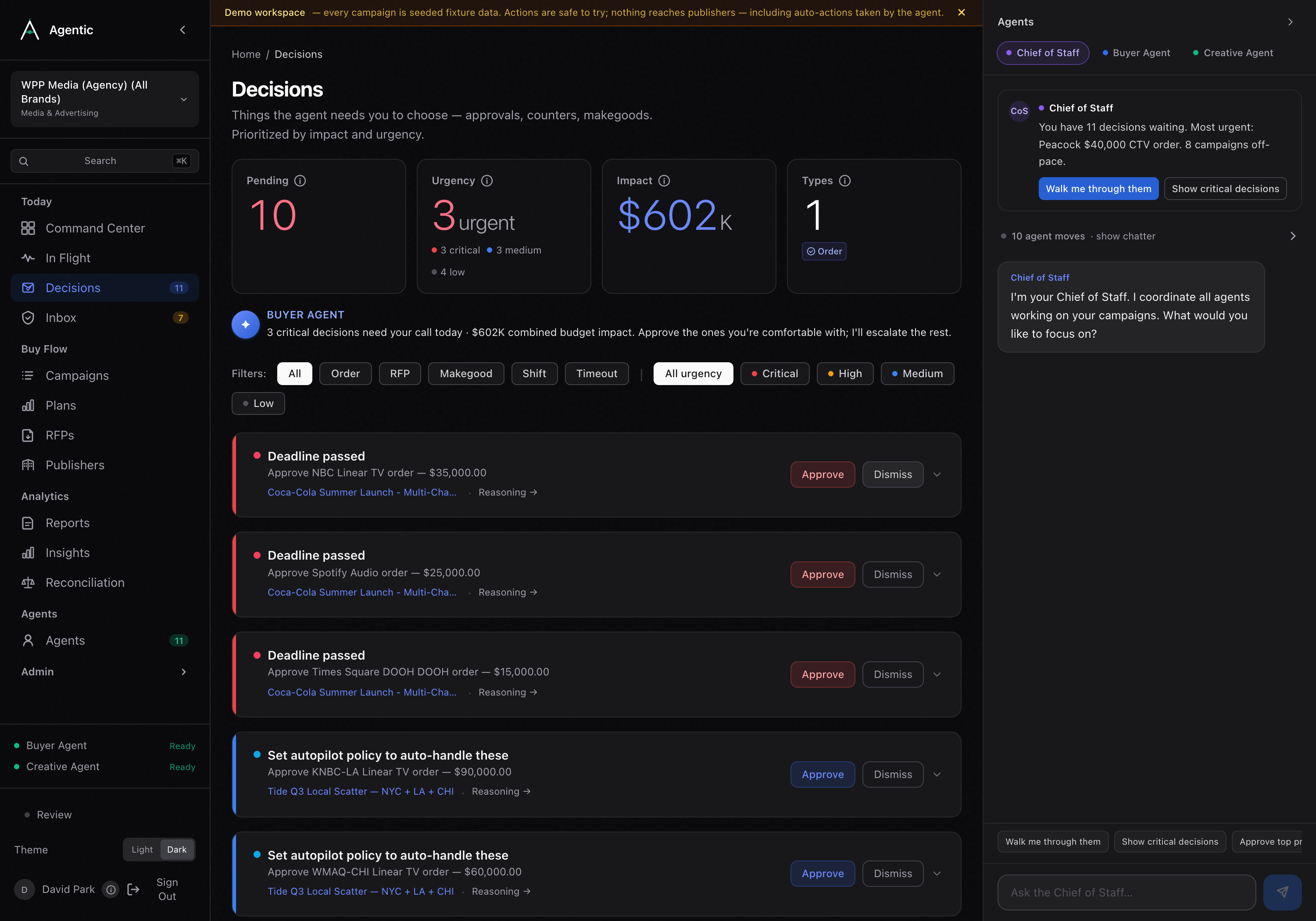
The decisions queue is the part I find most honest about what this product is. The automation is not there to remove the human; it is there to find the moments when the human is actually needed — and to get out of the way the rest of the time.
It is not automation that removes the human. It is automation that figures out when the human is actually needed.
I have been writing about the factory for months. The rules that make agents do their work correctly. The verification gates. The dashboard. All of it was building toward something. Products that run on their own, except for the decisions only a person should make.
Agentic Media is that pattern applied to a real industry with real economics. Campaigns running 24 hours a day, channels that never close, spend decisions that move fast. The operational volume is too high for a person to keep up with. The judgment calls are too important to leave to software alone.
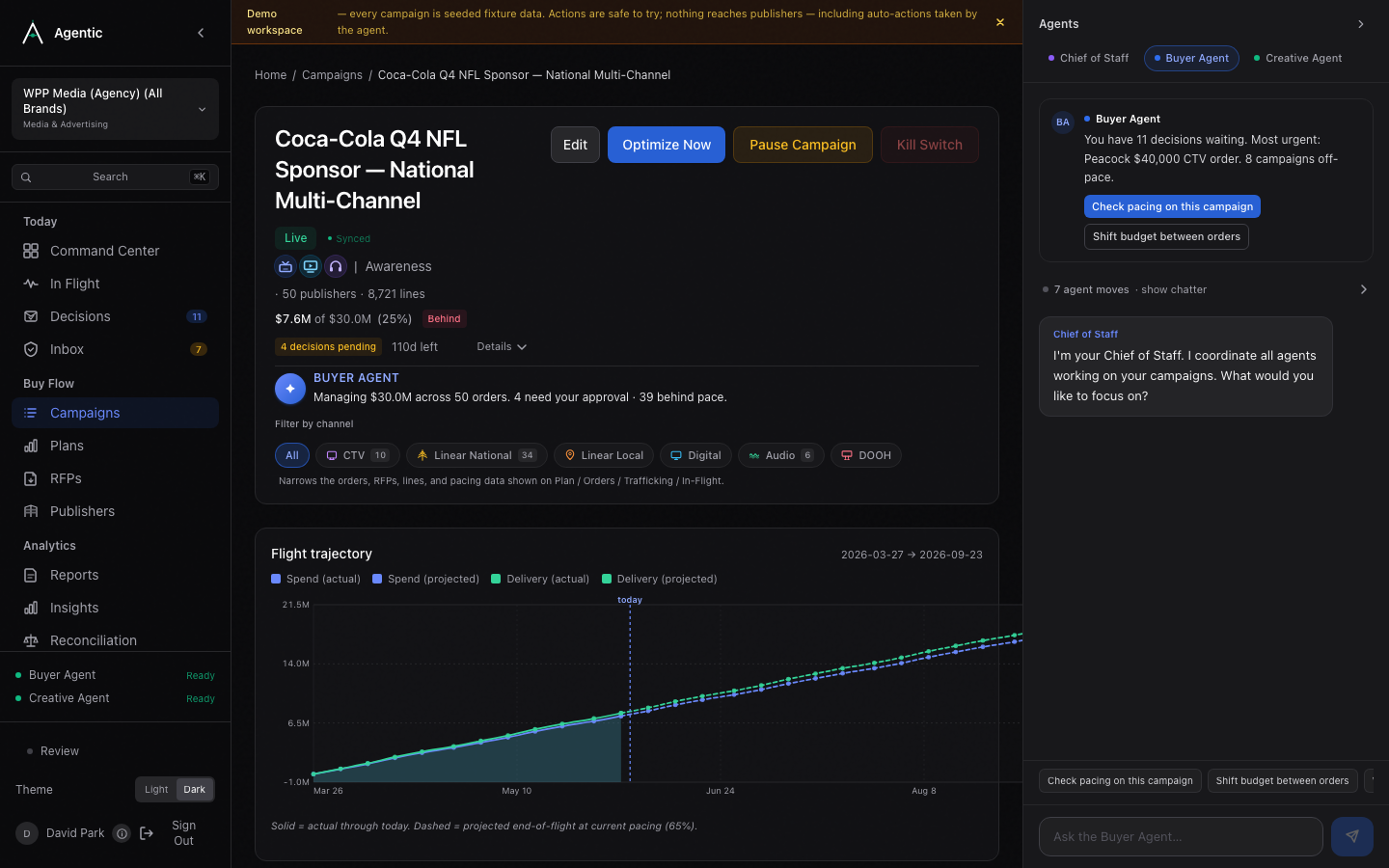
The same instinct that made me build the factory is what makes this product worth building. Agents are good at execution. Humans are good at judgment. The interesting work is drawing the line between them correctly.
Where it stands: it runs on synthetic campaigns, not real money. The buy-side — the agents that plan, book, and pace — is built and being validated; the next piece is wiring up the sell-side, the real publishers, so a campaign can actually run end to end. Whether agents can be trusted with real spend, real consequences, at real scale is exactly what the product is a bet on, and exactly what I have not proven yet.
Learnings
The factory posts were all about process. This one is the reason for the process. I was not building a factory because I love factories. I was building it because I had products in mind that needed agents to do the operational work while I stayed on the calls that actually required me.
Agentic Media is the first of those products visible enough to write about. What I am learning from building it is that drawing the line between agent work and human work is itself the product decision. Get that line wrong in either direction and the thing does not work. Too much to the human and you have software that just makes a slow person slower. Too much to the agent and you have a system no one trusts with real money.
The decisions queue is where that line lives. Every card in it is a case the agent decided it could not resolve alone. Getting that judgment right is the whole game.