
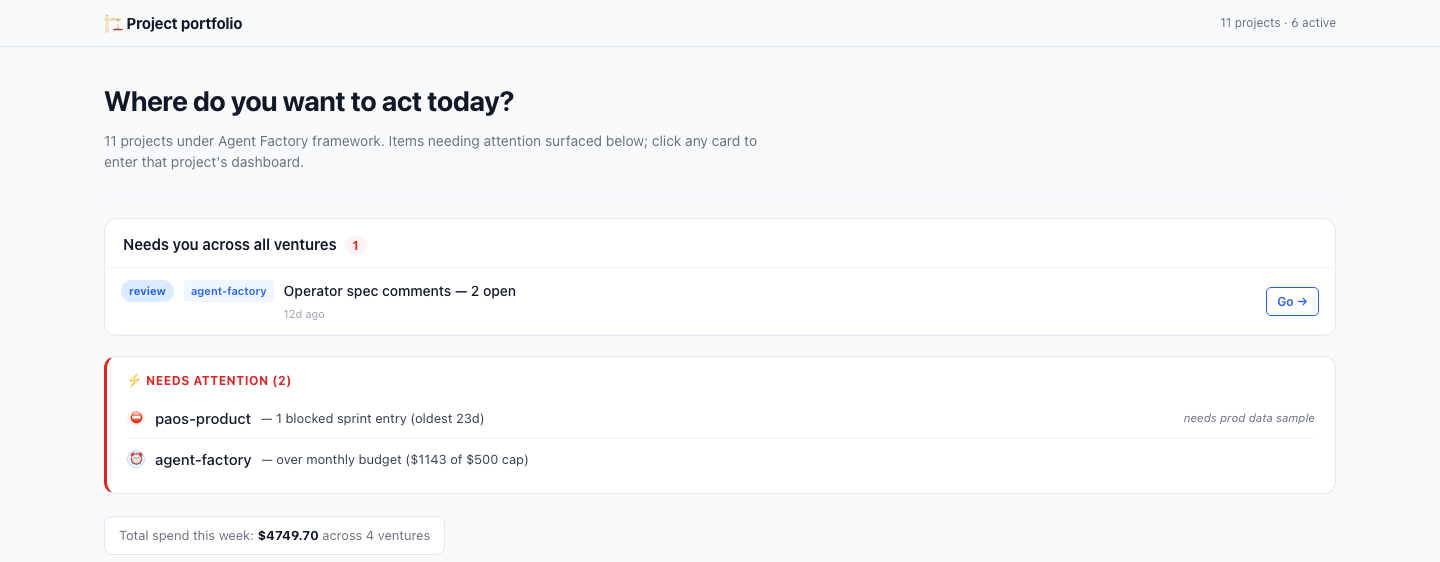
Status: in active daily use, unproven. This is the system I run my own work on — not a product for sale, and not a finished bet. Screenshot shows my own dashboard.
I keep calling it the factory, as if it were the workshop where the real products get made. The ad platform, the health assistant, the video app — those are the products. The factory is the bench they sit on.
I had that backwards. The factory is the project. It is the most ambitious thing I am building, and the products are partly a way of proving it works.
The factory does it not by working harder, and not by one clever AI that does everything. By a system.
It is made of unglamorous parts I have written about one at a time. Rules the agents read before they touch anything, so they stop guessing where I was unclear. Agents with real jobs — some build, some review, some exist only to find what is wrong — and a standing rule that none of them marks its own work done. Gates that catch the predictable shortcuts at the boundary. A memory, so what one session learns the next one starts from. A meter that shows what the agents are spending before the bill does. A dashboard where I see every product at once and step in only where I am needed.
None is impressive alone. Together they are what lets me hand real work to agents and trust what comes back — and trust is what makes the volume possible.
The volume right now: six products under one roof, more than two thousand commits in the last month, run by one person. Not a pace I could touch by hand. It exists because the agents do the building and the system keeps them honest enough that I can let them.
Whether the pace holds up is the open part. Whether more code, faster, also means more good code — or whether I am generating motion that looks like progress — I am still finding out. None of the products is finished.
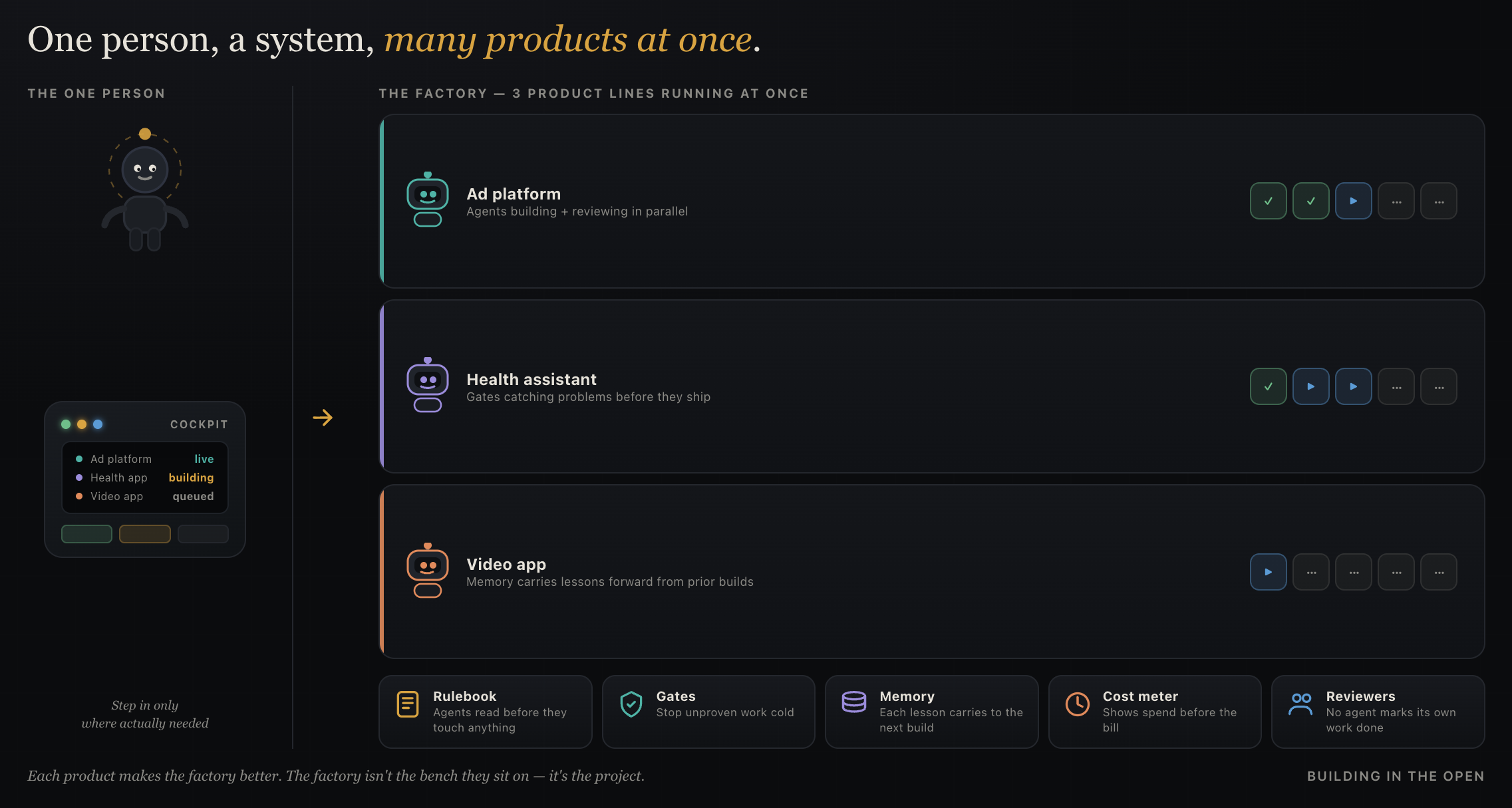
A single product is a bet on one idea. The factory is a bet that building itself can run at volume — that one person, inside the right system, can ship a portfolio that used to take a team for each line.
If the system is good, the next product is faster than the last: the rules are written, the agents know their jobs, the gates already catch the same mistakes, the memory holds what the last build learned. Each product makes the factory better; a better factory makes the next product cheaper. That compounding is the asset. The products are how I find out whether it is real.
That is why so much of my time goes into things that never show up on a screen — sharpening a rule, writing down yesterday’s mistake, building one more gate.
Learnings
I set out to build an assistant and ended up building the thing that builds. For a long time I treated that as a detour — the factory was overhead, the products were the point. The honest version is the reverse. Any one product can succeed or fail. The factory is the bet that one person, with the right system around a set of capable agents, can run a portfolio that used to need a team for each line of it.
The reason I keep investing in the boring parts — the rules, the gates, the memory, the meter — is that they are not boring at all once you see them as the product. They are the difference between an AI that does impressive demos and a system you can actually trust with real work, real money, and more than one thing at a time. That trust, built deliberately and in the open, is the project. Everything else is something the project made.