
The post you are reading wrote itself.
Every time I build something, there is a record of it: the running conversation with the AI tool I use to build software, kept across every product. Hours of it — fixes, wrong turns, moments the agents took the shortest path through an underspecified ask and I pushed back.
The best stories about building with AI were buried in that record, so I built a way to pull them out. The agents read back through the logs, find the arcs that went somewhere, and draft them as diary entries in my voice. The same AI that does the building now tells the story of the building.
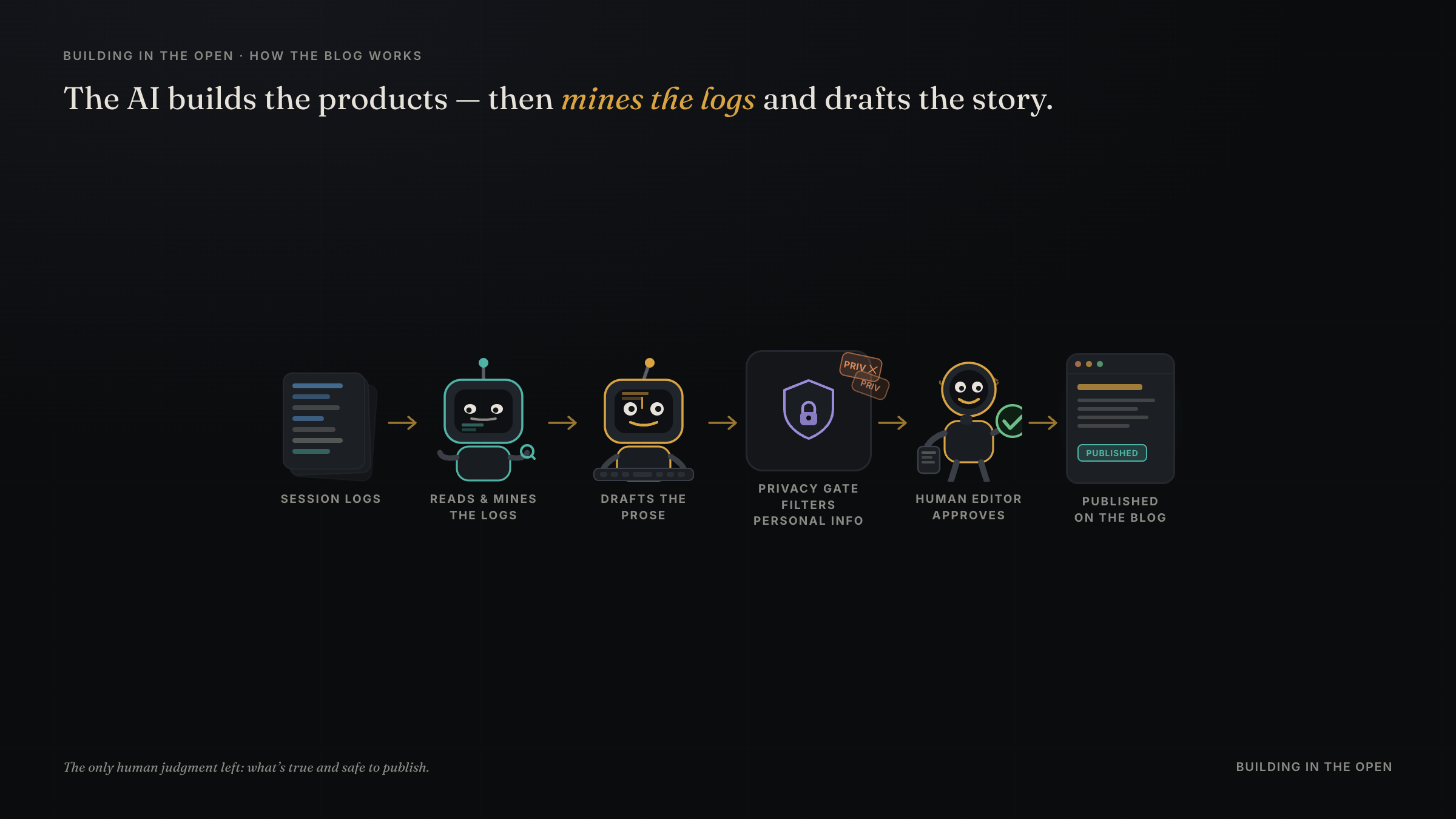
My part is narrower. I write the standard — what counts as a real story, what “sounds like a robot” means, what bends the truth and what just narrows a claim. A separate AI editor holds every draft to that standard and either ships it or sends it back. I sample what gets shipped; nothing waits on me to read it.
I used to assume review could not be automated — that catching an AI rounding a messy week into a clean arc, or stating a guess as fact, needed a person every time. So I wrote the rule down: what counts as “rounded,” what to verify against, where to insist on a number and where to soften, what the in-house vocabulary is. The editor walks every draft against it. The check is still there. It just is not me anymore.
Every draft also passes a privacy review before it goes near the page. The logs hold things that are not for a blog, and the line that keeps that material out is mine, set before a word goes public. The editor enforces it on every draft.
So this entry came out of my logs, found and written by the agents, held against my standard by an editor before it shipped. I wrote what “true enough and safe enough” means, then handed the per-draft call to an AI that holds every post to it.
Learnings
The most honest way to write about building with AI is to let the AI write it, from the real record, against a standard the person sets — what “true enough” means, what “safe enough” means — and let an editor enforce that standard line by line. I did not want a polished story about the building. I wanted the building to tell its own story, and a system to make sure the telling stays accurate and stays safe.
The recursion is not a gimmick. It is the most accurate version of what is actually happening here. The AI builds, the AI narrates, the AI editor checks. The human judgment left in the loop is the one furthest upstream: what “true” means in the first place, and what “safe” means before anything reaches the page.