I have written about the parts of this system one at a time. The rules. The agents with job titles. The gates. The memory. The dashboard. Each post took one piece and sat with it.
This one steps back. Here is how the pieces connect, and what actually happens to a single request as it moves through them.
Where this actually stands: this is the operating model I am building toward and increasingly running across my projects. Some parts work end to end today. Others are still uneven, triggered by hand, or being hardened. The products are how I find the weak spots before I mistake the diagram for the reality.
Start with me. I sit at a dashboard, which is just one screen that shows every product at once: what is moving, what is stuck, what needs a person. I am not down in the code. I am watching the whole floor and deciding where to point.
Say I point at one thing. A bug a user would hit, or a change I want made. That request is the ask. It does not go straight to an agent. It goes to an orchestrator first.
The orchestrator is the lead. Its job, when the system runs the way I want it to, is not to write the fix itself but to take my one sentence, turn it into a plan, break the plan into pieces, and hand each piece to the agent built for it. I give it the what. It works out the who and the how. In practice it still slips into doing the work itself, and pulling it back out is part of what I am hardening.
Then the agents go to work. This is the part people picture when they imagine AI building software, except it is not one agent doing everything. It is a team with real jobs. Some build. Some review. Some are there only to hunt for what is wrong with what the others just made. And the rule I keep tightening is that no agent signs off on its own work — whatever gets built is supposed to be checked by something that did not build it. Reviewers can still rubber-stamp, which is why I check the checkers.
What the agents produce does not just ship. It hits the gates.
The gates are the part I trust most, because they do not ask politely. A change without evidence that it works is supposed to come back, not pass. Not “looks done.” Not “the agent says it is done.” Evidence, or it stops right there. A determined agent can still route around a gate, so the gates are a floor, not a guarantee — and most of my edits to this system are about raising that floor.
When something does pass, two things happen at once. It ships, joining the other products running on their own lines. And whatever got learned along the way — a decision we settled, a dead end we hit — gets written into the memory, so the next build starts from it instead of paying to learn it again. That memory loops back to the agents. The next ask is a little cheaper than the last one.
And all of it reports back up to the dashboard, where I started. I watch it land. I step in only where a person was actually needed.
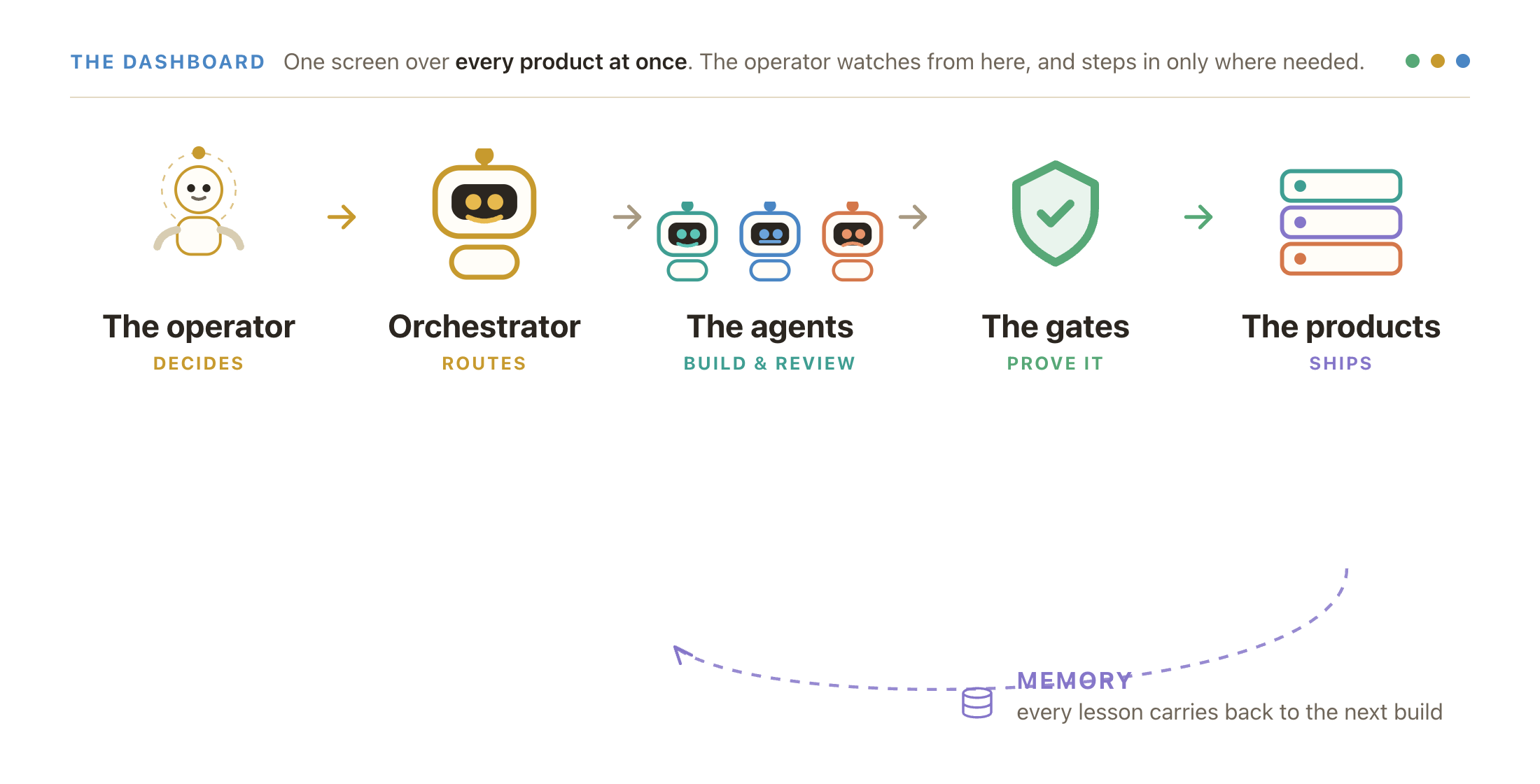
That is the whole machine. Five moving parts and a loop. None of them is clever on its own. The orchestrator is just routing. The gates are just rules that will not bend. The memory is just notes that get pulled back up at the right moment. What makes it work is that they are wired together, so I can hand real work to agents and trust what comes back without standing over every step.
For a long time I thought the products were the point and this wiring was scaffolding around them. It is the other way around. Any one product can fail. The thing that lets one person run several at once, and trust the output of each, is this shape. The shape is what I am actually building.
Learnings
The interesting question with AI is not “can it write the code.” It can. The real question is “can you trust what it hands back without checking every line yourself.” You cannot, not from the model alone. You get there by building the system around it: a lead that routes, a team that reviews each other, gates that stop unproven work cold, and a memory so the same lesson is not paid for twice.
My part in that system is narrow, and it is the part that does not automate. I decide what to point at, and I decide what “done” has to mean. The machine takes more of the execution each week, and my job is to keep finding the places where it still needs a person, a stronger rule, or a better gate. The machine, not any one thing it builds, is the project.