Status: working prototype — runs on my own machine, not launched. The economics are still an open question. Screenshot shows my own library.
The first thing I ever built was an app for long videos. You give it a ninety-minute talk and it hands you back the two minutes that matter: the key points, the moments worth jumping to, the gist without the sitting-through.
That was the November version: about seven hundred lines of Streamlit, built by pasting code back and forth with ChatGPT before I had ever touched a tool like Claude Code. It was a good toy. It summarized. But a summary only tells you what the person said. It does not tell you whether they were right.
That gap turned out to be the whole product.
From “what they said” to “is it true”
The people whose videos I was watching were mostly health experts. Long, confident, full of specific claims about sleep and food and exercise. And the thing I actually wanted was not a shorter version of the talk. It was to know which parts to believe.
So the app grew a second job. It reads the video, pulls out the factual claims one by one, and then goes and checks each one against the actual research — the same databases scientists use, PubMed and Semantic Scholar and the open medical literature. Not a thumbs up or thumbs down. The evidence: three studies back this up, here they are; this one is disputed, two studies say the opposite. You get to see the ground the claim is standing on.
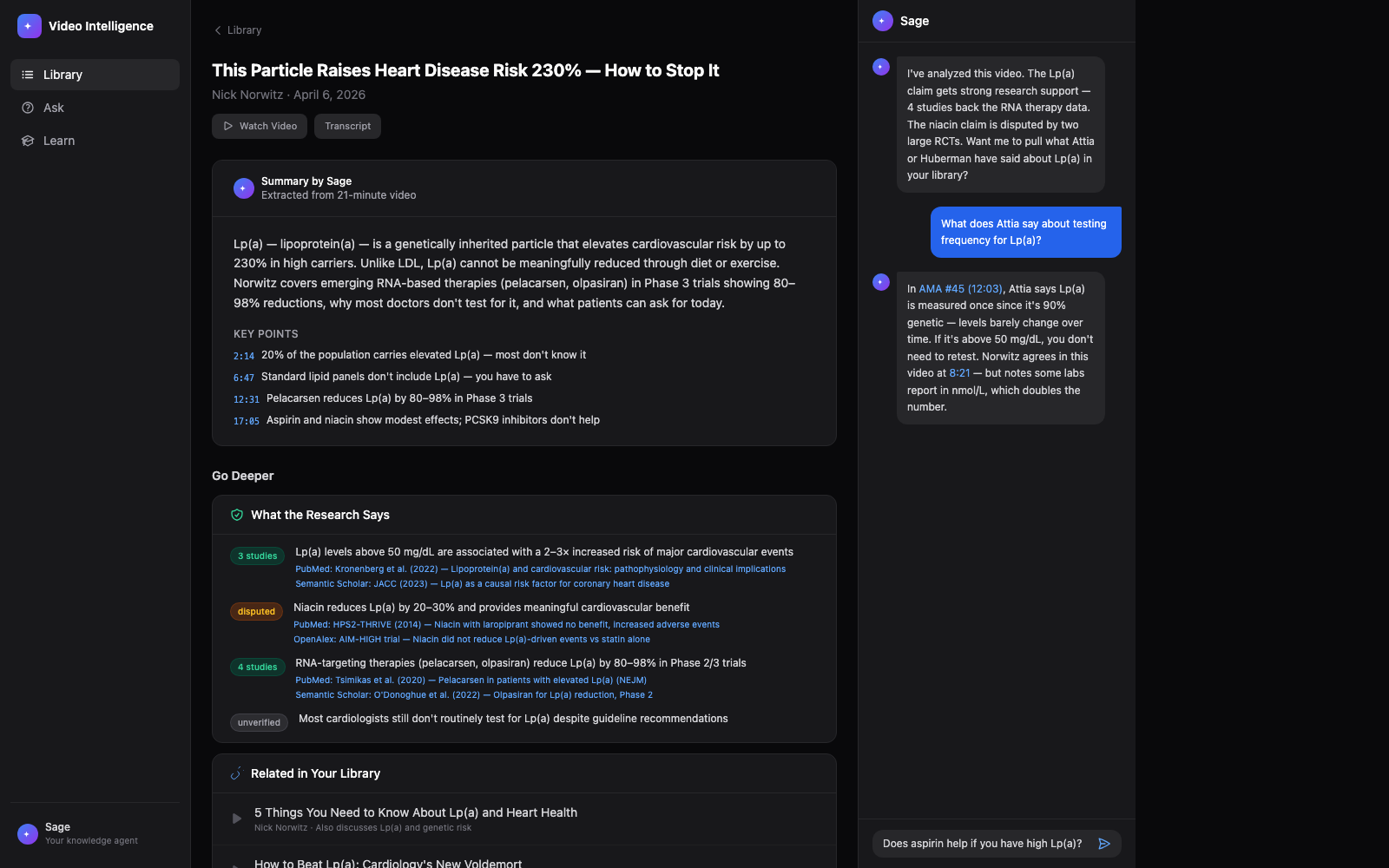
That is the part I care about most, and it is the part that is hardest to do honestly. Early on it faked it — I have written about the day I caught it stamping claims “supported” when all it had really done was match a few keywords. Catching that was what made real checking the point of the whole thing, not a feature on the side.
Where experts disagree
The feature people love is the one that catches the experts contradicting each other. One creator says do this. Another says the opposite. The app notices, puts them side by side, and shows what the research actually says about the disagreement. When two people you trust tell you opposite things, that is exactly the moment you want the evidence on the table.
Underneath, there is a quiet decision that makes the economics work. A video only gets read and checked once, ever. The first person to follow a creator pays the cost of processing them; everyone after gets the result instantly. The knowledge is built once and shared, which is the only way the numbers add up when the expensive part — the AI doing the reading — is almost the entire cost of running the thing. The database, the hosting, the search all round to nothing next to it.
Where it actually is, to be plain: it runs on my own machine, against my own library, and I have not launched it. And the economics are still an open question — when the reading is almost the whole cost, I am genuinely not sure the numbers work for anyone but a heavy user. It works for me. Whether it works as a business is the part I have not solved.
Learnings
I started this as a way to watch less video. It became a way to trust what I watched. The summary was the easy half and the part everyone else already builds. The hard half — does this claim actually hold up — is the half worth having, and the half that is genuinely difficult to do without lying about it.
The lesson that carried into everything I have built since came from here: the impressive-looking output is the easy part, and it is the part most likely to be faked. A confident summary is cheap. A claim you have actually checked against the research is expensive, and slow, and the only thing anyone should pay for. Build the expensive half, and be honest when you have not finished building it yet.