The button looks off. I type that and wait.
The agents come back with a fix. It is the wrong fix. They moved the wrong thing, because “off” could mean ten different problems and they picked one of them.
This keeps happening on the small visual stuff. The spacing is wrong. That feels heavy. The words leave too much room. I know exactly what I mean. The agents cannot see what I see, so they guess, and a guess on a layout is a coin flip.
I sit with it and the problem turns out to be me. I am describing a place on a screen instead of pointing at it. If a designer were sitting next to me, I would not write a paragraph. I would put my finger on the button and say this, here.
So that is what I build. A way to drop a pin right on the live screen. Click the element, leave a note on the exact spot. The pins are numbered. The agents read each one and fix what the pin is sitting on. Nothing to translate, and far less guessing about which button I meant.
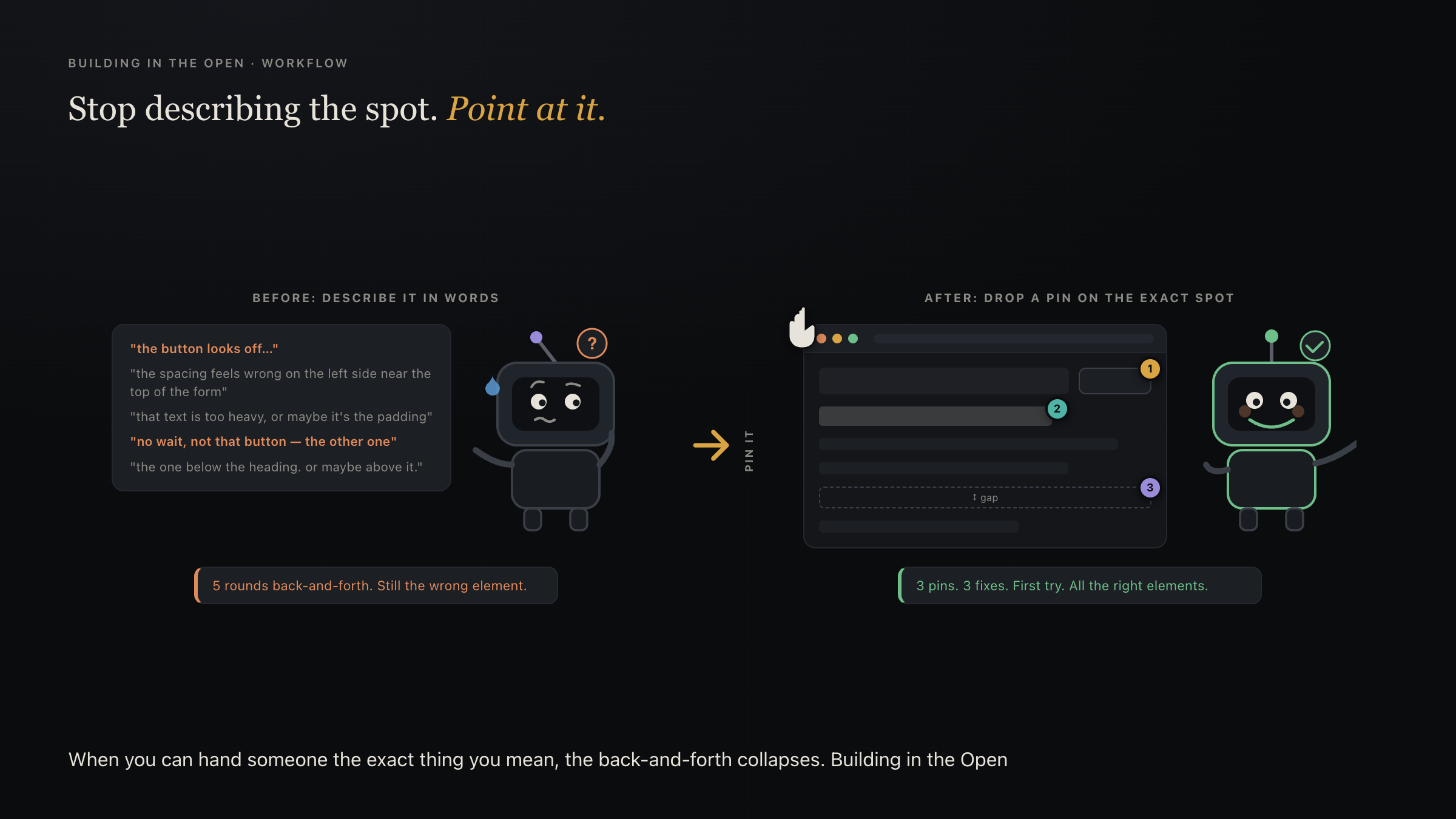
The first time I use it, the back-and-forth that used to run several rounds collapses to one. I drop a couple of pins. The agents fix the things the pins are sitting on. They are the ones I meant.
It is the same instinct behind the comment box on this blog. When something is wrong with a thing you can see, the fastest path is to touch it, not to write an essay about it.
Learnings
The fastest way to fix something visual is to point at it, not describe it. I kept losing rounds because I was turning a spot on a screen into words, and the agents were turning my words back into a spot. Every step of that lost something. The moment I gave myself a way to put a finger on the exact element, the guessing stopped and the fix matched what I saw on the first try.
The lesson holds past layout: when you can hand someone the precise thing you mean instead of a description of it, the whole back-and-forth collapses.