Day one with Claude Code. It is the tool everyone is talking about, and I cannot wait to try it.
A bit of background. Since November I had been using ChatGPT to write code for me: an app that takes long videos and turns them into summaries, key takeaways, suggested clips. Great learning. But it was all manual. Every time, ChatGPT wrote the code, then I copied and pasted it into the project myself, pushed it to GitHub, and ran the tests. Nothing like Replit.
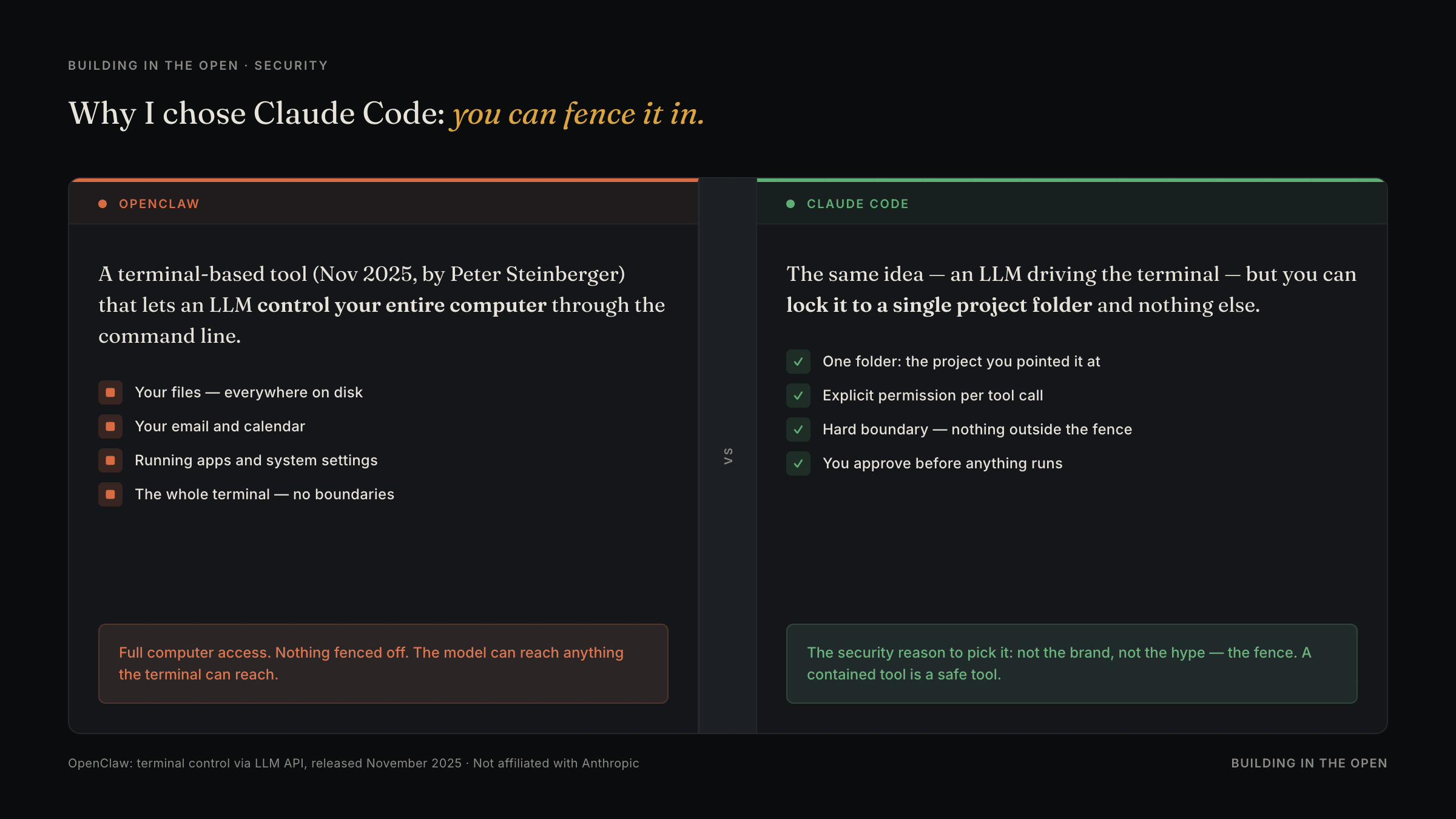
So when I come to Claude Code, I look at my options carefully. OpenClaw is out around this time. It is a framework for stringing different LLMs together and routing work between them — useful, but the piece I actually need is something that will sit on my laptop and build code. Claude Code is the closer fit. By default its writes stay inside the folder I point it at, not loose across my whole machine, and I can add stronger sandbox and permission controls as the work grows. It is not a perfect cage, and it does not need to be. It is enough separation to start experimenting without handing an AI unrestricted run of my laptop. That is why I pick it.
My first build with it — the first thing I make with Claude Code, after months of pasting code by hand from a chatbot — is an assistant I have always wanted. Something that helps me run my own days, that I can hand work to and trust to get it done.
I start building. Within hours I see something I did not expect. What is amazing is watching the agents do the work. I am not limited to one product at a time. I can do a lot more, a lot faster. That is the moment the idea of a factory shows up.
I want the building to take as little of me as possible. For that, the agents have to do the work, and agents left alone tend to produce confident, wrong output. So I start seeing what it will take to keep them honest. A quality check that reads what an agent produces and decides if it passes. A cost tracker, because agents spend real money and I want to see it before the bill arrives. A loop that lets an agent build, check itself, and try again without me there each time. A shared memory, so one agent writes down what it learned and the next picks up from there. I do not build all of that on the first day. What I have by the end of it is the list, the shape of what the factory will need. Most of the posts after this one are me building it, one piece at a time.
I keep building the assistant the whole time. The factory grows next to it, not instead of it. Later, I decide I want to turn the assistant into a real product. But that day I have both: a product I wanted, and the beginnings of a framework that builds products.
Learnings
I came in to build one assistant. What I noticed within hours was bigger: with agents that can build, my limit was no longer what I could do myself. It was how clearly I could say what I wanted and how well I could keep the agents honest.
So I started building both at once. The assistant, because I wanted it. And the framework that lets the agents do the building, because that carries into the next product, and the one after.